Bursting onto menus around the globe as a featured flavour, hot honey is the latest food sensation that’s tickling the tastebuds of consumers — from casual diners to connoisseurs. Now, a uniquely Canadian version has hit the market as a result of an applied research project at RRC Polytech.
Bee Maid Honey Limited, a co-operative owned and operated by over 300 Western Canadian beekeepers, recently partnered with RRC Polytech’s Prairie Research Kitchen (PRK) to develop its own signature version of hot honey that uses chipotle to bring smoky heat to its traditionally sweet and pure product.
“Bee Maid’s chipotle hot honey is a tasty example of how the Prairie Research Kitchen leads food innovation by supporting companies and communities with access to state-of-the-art facilities and a team of professional and student researchers who specialize in blending food science with culinary skills to solve specific challenges,” says PRK Director Mavis McRae.
 Many hot honey products popularized in the US refer to its breakthrough use in the Nashville area and rely on a nondescript pepper blend to achieve its ‘hot’ characteristic, focusing more on heat than flavour. Bee Maid’s experts worked closely with the PRK team to develop a 100 per cent Canadian version with heat from a defined flavour profile that chefs with refined palates can instantly identify and trust to be consistent in their recipes.
“For over 70 years, Bee Maid has proudly packed the finest-quality white, golden and amber honey produced in Alberta, Saskatchewan and Manitoba,” says Shannon Bowden, Senior Brand and Communications Manager at Bee Maid. “Our iconic brand is world-renowned for traceability, quality assurance and sustainability — but prior to collaborating with the Prairie Research Kitchen we didn’t have the staff or product development resources to fully explore flavour enhancements like this.”
After connecting at Food and Beverage Manitoba’s annual Cultivate Sustainability Conference and Trade Show, PRK and Bee Maid’s shared mission to ensure this innovative food trend becomes a new standard was clear — and time was of the essence. So, the first-time partners got right to work swarming the problem with their collective expertise.
 “Creating a great tasting new product that will stand out in a competitive marketplace was only part of the challenge in this project,” says McRae. “Honey crystallizes quickly when other ingredients are introduced so we had to perform many trials to determine the right combinations for a hot flavour profile that would complement and elevate Bee Maid’s delicious amber honey, while maintaining its smooth texture and prolonging its shelf life.”
After months of sensory and stability testing to perfect the process, the final product was launched and received rave reviews at Toronto’s annual Restaurants Canada Show, the nation’s largest hospitality and food service trade event. Gordon Food Service is currently distributing it to customers across Canada under its Brickman’s Brand, and it’s already featured prominently on the menus of local restaurants.
A Little Pizza Heaven now offers the ‘Heavenly Hot Honey’ — a buzzworthy combination with chicken, bacon, spinach and roasted red peppers — as part of its gourmet lineup, and suggests a hot honey drizzle as a flavour upgrade on any pizza.
“We tried it and loved it,” says co-owner Dave Fox. “It was a no-brainer for us to add a high-quality ingredient that’s trending with our customers, but there’s also tremendous value in supporting local honey producers because it’s our philosophy that cooperation within the sector drives economic success for everyone across the province.”
Working together for mutual benefit has been a consistent theme on the project. RRC Polytech’s Culinary Arts students and chef instructors also gained valuable experience through the project, by testing their own creativity when showing off the honey’s versatility in a recent culinary competition.
 With an innovative new food item that serves as a testament to teamwork and the importance of surrounding oneself with a strong hive, Bee Maid is confident the project’s success will linger like the layers of flavour in its chipotle hot honey.
“Adding a little spice to our classic lineup of products immediately ignited sales with our commercial clients and we’re hopeful a retail option will be coming soon,” says Bowden. “We couldn’t have done it without our partners at PRK, so we’re excited to continue building relationships that allow Bee Maid to explore new product opportunities, increase market growth and demonstrate our belief in the power of collaboration.”
To access RRC Polytech’s vast array of technology, expertise and facilities, email rpi@rrc.ca.
]]>
Today, Prairies Economic Development Canada (PrairiesCan) announced a $3.3-million investment that will expand applied research capacity at RRC Polytech’s Vehicle Technology & Energy Centre (VTEC), helping local manufacturers and businesses in sectors vital to Manitoba’s economy to address gaps in their ability to innovate on the path toward zero emissions.
“Building a stronger, more competitive Canadian economy means investing in the Prairies’ unique strengths,” said the Hon. Eleanor Olszewski, Minister of Emergency Management and Community Resilience and Minister responsible for Prairies Economic Development Canada, in a news release.
“Our new government is helping Manitoba’s heavy equipment and vehicle sector innovate, adopt new technologies and create good jobs for workers and opportunities for local business. Together we are strengthening Canada’s clean industrial economy and ensuring we build Canada strong.”
The federal investment will help establish the Innovation Garage at RRC Polytech, in partnership with the Vehicle Technology Centre — a non-profit that works to accelerate Manitoba’s heavy equipment and vehicle (HEV) manufacturing cluster — the province, and private-sector partners. The funding is in addition to the $3.3-million investment made by the provincial government.
“This investment builds on the strength of Manitoba’s heavy equipment and vehicle sector, which exports around the world and supports thousands of good jobs right here at home,” said the Hon. Jamie Moses, Minister of Business, Mining, Trade and Job Creation, in a news release.
“By partnering with industry and RRC Polytech, we’re helping companies adopt new technologies, scale up and bring more made-in-Manitoba innovations to the global market.”
The Innovation Garage is a flexible project space that will enable academic researchers and industry partners to work together to advance research and development of processes and products that support the HEV sector and accelerate the province’s transition to a low carbon economy.
It will feature leading-edge equipment, tools and technology, including a microgrid lab focused on energy innovation and HEV infrastructure, and a hydrogen and fuel cell lab to advance clean propulsion systems and other new technologies.
 “The Innovation Garage at RRC Polytech is about preparing Manitoba’s manufacturing sector for the challenges and opportunities of a changing world,” says Fred Meier, President and CEO, RRC Polytech.
“As industries transition to cleaner energy and work to address climate change, this investment provides the technology, expertise and collaborative space needed to innovate quickly and efficiently. Together, we’re building solutions that make our province more competitive and more sustainable for generations to come.”
The Innovation Garage strengthens RRC Polytech’s relationship with the Vehicle Technology Centre by increasing the institution’s support of and collaboration with Manitoba’s HEV manufacturing leaders. This will help small- and medium-sized enterprises adopt new technologies, strengthen workforce skills and bring more made-in-Canada innovations to market.
The project will also support the Vehicle Technology Centre’s Clean Technology and Advanced Manufacturing program, which helps manufacturers leverage their investments in industrial applied research and development.
“Manitoba’s heavy vehicle and equipment manufacturers drive market leadership through ongoing innovation,” says Ron Vanderwees, President and CEO, Vehicle Technology Centre.
“Today’s announcement will allow our manufacturers to conduct industrial-scale advanced research on site at RRC Polytech in collaboration with academic researchers, suppliers and contractors. Combined with the Clean Technology and Advanced Manufacturing program funding announced today, this investment will accelerate innovation in our regional cluster and build the research expertise needed for continued success.”
The Innovation Garage is an exciting evolution in RRC Polytech’s commitment to elevating industry and community through practical training and applied research. It’s an opportunity to collaborate with more of the province’s best and brightest to support digital transformation and develop more advanced and sustainable manufacturing processes and products that are critical to the adoption of cleaner tech.
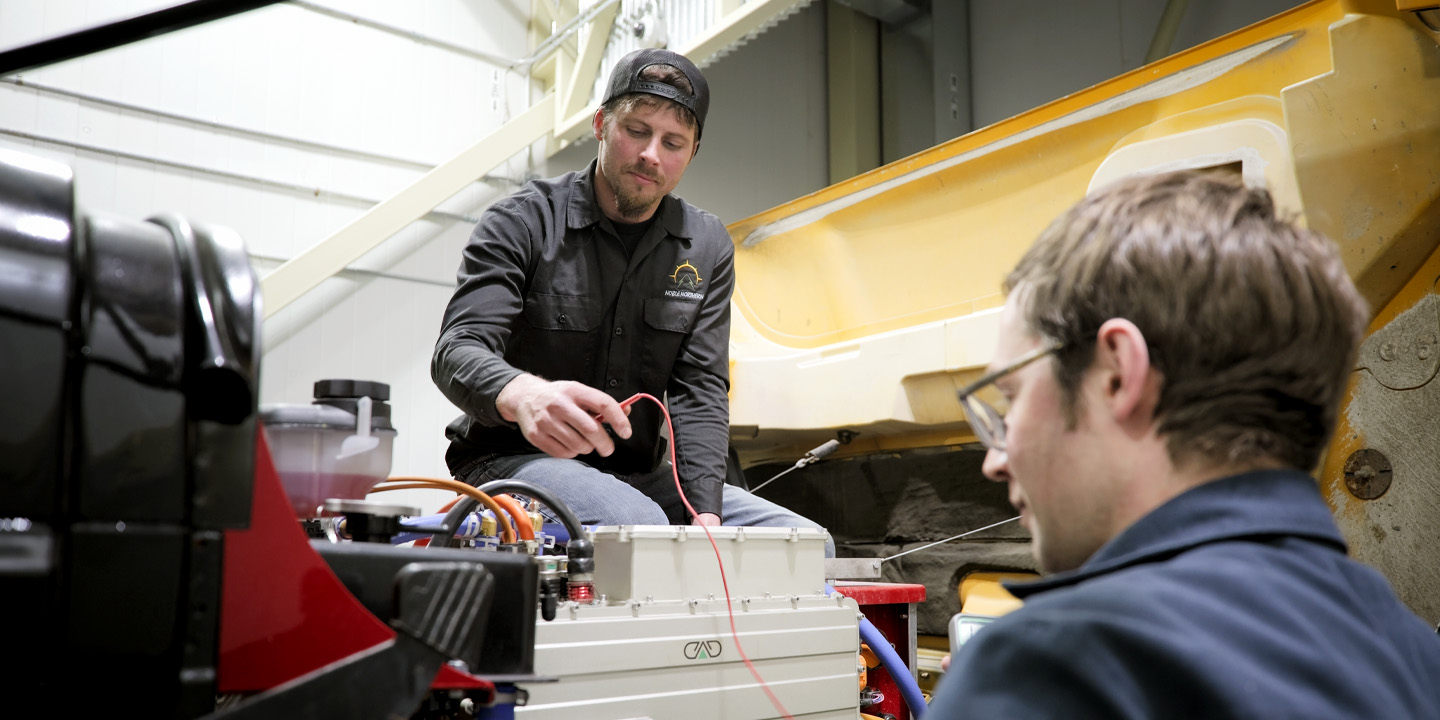 The impacts are often cumulative. Groundbreaking projects like developing the world’s first electric tundra buggy with Noble Northern established RRC Polytech’s VTEC as a proven hub for innovation that specializes in the testing, validation and demonstration of emerging vehicle technologies and alternative energy systems.
Knowledge from that project was then applied to the creation of a diesel-to-electric conversion kit for school buses, which could be further adapted to help subsequent partners convert fire trucks, farm machinery and other heavy equipment to more efficient power sources.
The addition of the Innovation Garage will expand VTEC’s capacity to conduct technical exploration, increase commercialization and introduce a broader spectrum of technologies to assist more local companies to accelerate their clean technology transition while offering practical experience to students.
“RRC Polytech’s collaborative efforts to support digital adoption and advance clean technology across all sectors is ongoing daily,” says Meier. “The new resources made possible by today’s investment empower our experts in Research Partnerships & Innovation to expand their work, and to seek and strengthen relationships that drive sustainable progress and economic prosperity for all Manitobans.”
]]>As governments, industry and academia work collectively to strengthen Canada’s economy, RRC Polytech’s Price Institute of Advanced Manufacturing and Mechatronics is proud to launch the new Centre for Automation and Manufacturing Technology Transfer (CAMTT) — a vital solution designed to drive technology adoption across the sector while training the workforce of tomorrow.
Serving as a hub to connect business and industry with applied research, innovation, technology transfer and talent, CAMTT will strengthen our workforce and economy by helping small and medium-scale enterprises in Manitoba address productivity through automation, artificial intelligence, robotics and mechatronics.
By leading collaborative projects as they upskill and reskill in their careers, students at the Price Institute will gain valuable experience solving real-world challenges.
“CAMTT is a collaborative workspace where industry and academic partners can work together to bridge gaps by accelerating the acquisition and adoption of existing and emerging technology,” says Fred Meier, President and CEO, RRC Polytech.
“Our students will not only hone their skills by leading applied research projects — their insight, energy and expertise will lead to innovative solutions that support Manitoba businesses in today’s competitive global market.”
CAMTT is the first of its kind in Manitoba, with a new working space that can connect faculty, students and partners anywhere in the world. Manufacturers-in-residence will effectively guide teams dedicated to each venture as they experiment to perfect new concepts and processes under a shared vision.
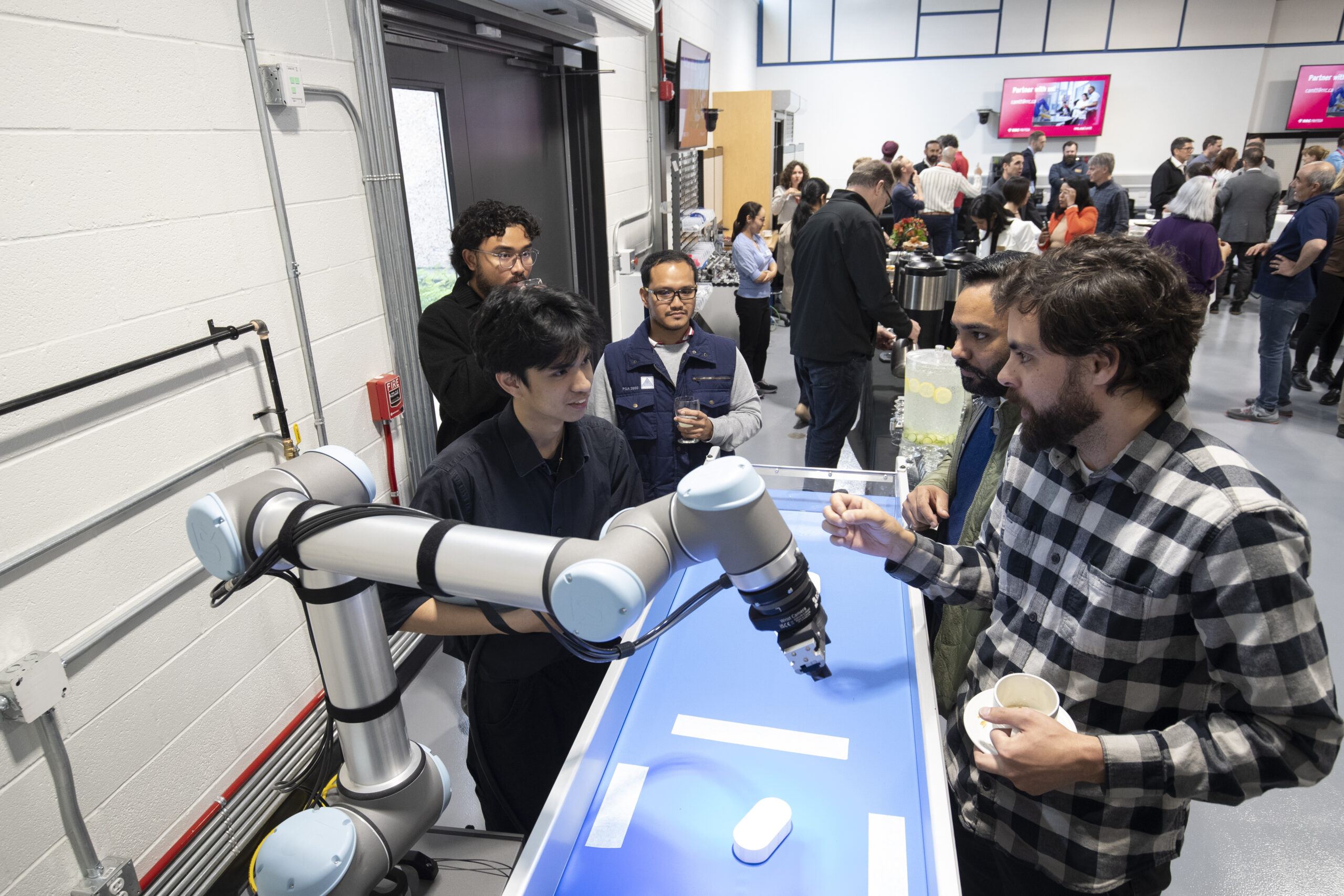 An initial success story is already in use on the production line of a local manufacturing leader, and the namesake of the Price Institute. In CAMTT’s inaugural project, a student-led team worked with the Price Industries’ Electronics division to automate a time-consuming manual inspection process.
Together, they created a trainable automatic vision system that combines hardware with a camera to capture images of printed circuit boards with trainable software that uses AI to predict and validate whether they pass quality control and quality assurance metrics of production.
“The students did a great job to get a working test fixture completed, tested accurately and deployed into our production line,” says Mike Nicholson, C.E.T. General Manager, Price Electronics. “We look forward to our next project at CAMTT as we continue integrating components that optimize cost, time, quality and efficiency.”
Partners can expect extensive cost-effective collaborative projects that leverage all of RRC Polytech’s research facilities and resources — including funding through the Digital Technology Transformation Initiative — and that are positioned for success by maximizing emerging technologies, state-of-the-art equipment and outside-the-box thinking to tackle specific challenges.
“CAMTT takes an interdisciplinary approach to system, product and solution development helping manufacturers harness emerging technology to reduce their labor market challenges, while training their future workforce,” says Dr. Vikram Banthia, Director of RRC Polytech’s Price Institute of Advanced Manufacturing and Mechatronics.
“Partner with us to leverage our technology, innovation, expertise, assets and talent and take your project from idea to reality.”
]]>RRC Polytech is bringing down costs for Canadians and helping them get ahead by continuing to grow its critical role in Canada’s low-carbon transition, along with its capacity to train the workforce of today and tomorrow.
An established research leader in clean energy, EV and battery technology and sustainable construction, RRC Polytech is unleashing the power of pan-Canadian collaboration to make housing more affordable, catalyze change in the construction sector and create new jobs in the skilled trades.
With support from a $11.3 million investment from the Government of Canada’s Sectoral Workforce Solutions Program, RRC Polytech is joining its Canadian Colleges for a Resilient Recovery (C2R2) partners in a national green construction training initiative to upskill and reskill Canadians to build and retrofit homes and buildings that reduce energy consumption in pursuit of the ambitious targets of net-zero emissions by 2050 and a net-zero electricity system by 2035.
Home to Manitoba’s only Building Efficiency Technology Access Centre, RRC Polytech will use the funds announced last week to drive economic growth while helping Canada meet its climate and housing goals by working with its industry and academic partners to develop and deliver practical, innovative training in sustainable construction.
“This nation-wide training initiative is the latest example of how RRC Polytech’s flexible learning model and vast applied research facilities and expertise — combined with our commitment to foster collaboration with industry, communities and government — uniquely positions us to not only support but to lead the low-carbon transition,” says Fred Meier, RRC Polytech’s President and CEO.
Accessible, industry-aligned training that equips workers with the technical and leadership skills they need to adopt green building practices, create sustainable designs and upgrade existing aging infrastructure will be offered through the Quick Train Canada platform — exclusive to RRC Polytech in Manitoba — with the first intake in Building Science for the Retrofit Sector scheduled for November.
The next phase of available courses will be launched this winter, as funding through the Advancing Access and Skills Training for Green Buildings and Retrofits initiative will be available until March 2028.
“This project-based funding allows us to expand our available suite of clean energy training and share that knowledge with our C2R2 partners while helping to reduce fees for students — making this an affordable choice for local industry leaders to upskill their workforce and for individual learners who want to expand their knowledge to maximize on the opportunities created as the province transitions to a low-carbon economy,” says Jill Latschislaw, Director of Corporate Solutions, Indigenous Strategy, Research and Business Development.
RC Polytech already offers multiple energy transition related micro-credentials, previously developed with its industry and C2R2 partners. Their modular design allows delivery to be tailored to a client’s needs through online/hybrid options, regional campuses and Mobile Training Labs.
This customized training, along with continuous curriculum reviews of all programs, ensures workers are being prepared to use, maintain and upgrade the innovative products, processes and technology being developed using the Polytech’s extensive applied research resources.
Working closely with such partners as the Manitoba Environmental Industry Association, RRC Polytech aims to further expand training and research to support the province’s commitment to building the next generation of clean energy.
]]>This week, RRC Polytech and its post-secondary partners across Canada proudly launched Labs4, an applied research commercialization engine aimed at supporting entrepreneurs and accelerating the country’s innovation economy.
Labs4 brings together 38 Canadian polytechnics, colleges and universities to collaborate with businesses, entrepreneurs and communities on transforming research into real-world solutions.
Initially known as the College-University Lab to Market Network for Entrepreneurship and Research Commercialization, Labs4 will develop and deliver hands-on entrepreneurship training, product development support and mentorship through eight regional hubs and three Indigenous entrepreneurship hubs that stretch from coast to coast.
“Labs4 is built for impact. This is innovation with purpose, delivered across every region and rooted in community,” says Dr. Jolen Galaugher, Executive Director of Research Partnerships & Innovation at RRC Polytech and chair of the Labs4 executive committee.
“We operate at the intersection of academia and industry to translate applied research into practical solutions. By teaching researchers and businesses how to work with each other, building stronger relationships with Indigenous communities and scaling innovation with intentional speed and purpose, we’ll equip entrepreneurs to quickly move from insight to action to benefit all Canadians.”
Funded by the Natural Sciences and Engineering Research Council of Canada (NSERC), Mitacs and its institutional partners, Labs4 is a $55-million initiative created to close the gap between research and commercialization across all Canadian sectors, while reducing barriers faced by equity-seeking groups and strengthening Indigenous and regional innovation.
Leveraging state-of-the-art facilities and subject-matter expertise available at network institutions will expedite entrepreneurs’ and creators’ ability to take new products and processes to market, ensuring both economic and social impacts are felt sooner.
Three signature pillars differentiate Labs4:
- Indigenous Entrepreneurship Hubs: Incubators in Saskatchewan, Manitoba and Ontario provide culturally grounded programming, mentorship and wraparound supports tailored to First Nations, Métis and Inuit researcher-entrepreneurs. Programming is led by Indigenous institutions and rooted in self-determined goals, ceremony and community priorities.
- Technology Readiness Level-Up (TRL) program: A four-month placement in polytechnic- or college-based applied research facilities, where researcher-entrepreneurs receive $10,000 stipends to develop, test and validate prototypes with expert mentorship. (The TRL program is already underway; applications are now open for the upcoming fall cohort.)
- Market to Lab (MtL) program: A two-month simulation in which researcher-entrepreneurs lead student teams to solve real-world commercialization barriers. With mentorship from business and innovation experts, participants gain leadership experience and build go-to-market strategies.
Labs4 is poised to drive measurable national impact and support hundreds of researcher-entrepreneurs to explore the launch of new research-based ventures. The initiative supports not only new ventures and commercial products but also economic development, job creation and inclusive growth across all sectors and regions.
“We are dedicated to creating pathways for innovation and amplifying the impact of Canadian research on the global stage,” says Nasil Nam, National Director of Labs4.
“Whether it’s a prototype in a lab or a venture ready to launch, we meet researcher-entrepreneurs where they are and help them move forward with confidence. Our work is practical, fast-paced and focused on impact.”
]]>Manitoba’s first low-carbon school bus — converted from diesel to electric power — rolled out of RRC Polytech’s Vehicle Technology & Energy Centre (VTEC) this week, demonstrating the viability of a cost-effective process to electrify current vehicle fleets and reduce the environmental impacts of fossil fuels.
Funded by the province’s Conservation and Climate Fund and the Canadian Shield Foundation, the diesel-to-EV school bus conversion kit is the result of collaboration between VTEC’s expert researchers, industry partners Northern Noble and representatives from the Seven Oaks School Division. The conversion kit reduces greenhouse gas emissions, cuts costs for schools and the government, and offers an affordable alternative to factory-built electric buses.
“Our work on the electric school bus conversion kit is the latest example of how applied research collaborations with industry partners support market-driven innovation and product development,” says Fred Meier, President and CEO of RRC Polytech.
“This project is an example of the applied research expertise and facilities RRC Polytech has developed over the last 20 years that contribute to advancing technologies to support Manitoba’s energy transition.”
The project began in August 2023, when Seven Oaks provided a bus suitable for conversion and students from RRC Polytech’s Heavy Equipment Mechanic program removed its diesel engine before transferring the bus to the team at Noble Northern.
VTEC’s researchers then joined Noble Northern — with whom they’d partnered years earlier to help develop an EV Tundra Buggy for Frontiers North Adventures — in laying the groundwork for converting the bus, including the preliminary design for the electric drive system and the procurement of electric motors, batteries, controllers, inverters and other essential accessories in the conversion kit.
After the installation and commissioning phase, the newly converted bus was returned to RRC Polytech for rigorous environmental performance evaluations within MotiveLab , VTEC’s climatic chamber.
Even with labour costs considered, using the conversion kit to retrofit an existing diesel bus saves over $100,000 compared to the price of a new factory-built electric bus, freeing up valuable budget for school divisions to reinvest directly into their classrooms while significantly reducing their carbon footprint.
The benefits of converting just one bus also include up to $11,000 in fuel cost savings and a reduction of 21.6 tonnes of carbon dioxide emissions per school year, as well as lower maintenance costs and the elimination of air and noise pollution.
“VTEC is proudly regarded as a Canadian leader in EV technology,” says VTEC program manager Jojo Delos Reyes. “By seeking cost-effective methods to reduce emissions and source renewable energies for fuel for fleet vehicles like school buses, we’re helping to build and maintain a sustainable future while training the workforce of tomorrow.
“This successful collaboration has proven what is possible — now we’re ready to literally drive it forward. Our next steps are to explore commercialization and scaling possibilities of the conversion process, and to connect with partners who are interested and motivated to adopt this new technology.”
At an on-campus unveiling event this week, the Hon. Mike Moyes, Minister of Environment and Climate Change, heralded the project team for its commitment to the environment and the economy.
“Manitoba is committed to advancing clean transportation solutions that protect our environment while ensuring safe and sustainable mobility for students,” said Moyes.
“We’re thrilled that the result of this collaboration … not only offers an alternative to importing costly technology, but the potential to stimulate our local economy through job creation and growth.”
]]>RRC Polytech’s Prairie Research Kitchen (PRK) has joined an applied research consortium — made possible by a $1.2-million investment from Protein Industries Canada (PIC) — aimed at exploring agri-food opportunities and addressing barriers to food security in rural and remote communities in Manitoba.
The $1.6-million project finds staff and students from PRK and the University of Manitoba’s (UM) College of Rehabilitation Sciences at the Rady Faculty of Health Sciences working together with communities across the province to address food insecurity and Indigenous food sovereignty barriers related to First Nations and Red River Métis food production and distribution systems.
“I am pleased to be announcing a new partnership as part of a consortium, together with RRC Polytech and the University of Manitoba, and enabled by the commitment and funding provided through Protein Industries Canada,” said David Beaudin, Minister of Agriculture and Associate Minister of Provincial Education for the Manitoba Métis Federation (MMF), in a news release.
“This project will help facilitate the reimagining of Red River Métis food systems and will unlock new opportunities to better connect with our foods across the National Homeland of the Red River Métis. I look forward to seeing the project build value through capacity and skills development, all while enabling greater local access to nutritious food options.”
Food security exists when all people — at all times — have access to sufficient, safe and nutritious food. It’s not just about having enough food — it also means having the ability to access it and use it in a way that supports a healthy, active life.
Fresh, nutrient-dense groceries often come with a hefty price tag in rural and remote Indigenous communities. The new consortium will work with Red River Métis and First Nations communities in Manitoba to increase access to affordable, nutritious, supply-stable and culturally appropriate food while creating community-specific recipes that incorporate pulses and other plant-based ingredients.
The creation of these options aims to nourish and nurture long-term health outcomes, while increasing opportunities for student learning and jobs and contributing toward future Indigenous economic development.
“The investments into this project are advancing the future of food for all Canadians,” says Protein Industries Canada CEO Robert Hunter.
“Diversifying the value-added sector provides protein options and country-wide economic growth that supports the expansion of Canada’s plant-based food and ingredient ecosystem. It’s equally important that we invest in communities and economic reconciliation with Indigenous people, ensuring the growth of this industry supports inclusion, shared prosperity and long-term partnerships across the country.”
Throughout this project, RRC Polytech, MMF and UM will engage community members, hire students and interns, perform market research on both food products and future resource applications, develop food products, teach hands-on classes and develop workshop materials to engage communities in food production and cooking skills.
The project will provide a case study for engaging in respectful discussions with Indigenous communities and creating an example for other organizations to follow.
“RRC Polytech is committed to elevating Indigenous Peoples and communities, so we’re excited for our team of experts at Prairie Research Kitchen to join our partners in this transformative initiative,” says Jamie Wilson, Vice-President, Indigenous Strategy, Research and Business Development, RRC Polytech.
“PRK’s professional staff and student workforce has led the way in embracing Truth and Reconciliation within our College community, and across the province at large, by being the first to create Indigenous research positions, mandating Four Seasons training for all staff, engaging students from the Indigenous Culinary Skills program and actively pursuing and supporting Indigenous entrepreneurs.
“Their knowledge, understanding and eagerness to collaborate will be a tremendous asset to the project.”
]]>PrairiesCan is investing $899,500 into the Prairie Polytechnic Innovation Network Accelerating Commercialization for Local Ecosystems (P2INACLE).
A network of leading Prairie polytechnic institutions — including Red River College Polytechnic (RRC Polytech), Northern Alberta Institute of Technology, Northwestern Polytechnic, Red Deer Polytechnic, Saskatchewan Polytechnic and Southern Alberta Institute of Technology — P2INACLE will drive social, economic and technological innovation across Western Canada by providing businesses with access to facilities, equipment and research expertise.
Led by Saskatchewan Polytechnic, P2INACLE will launch its first pilot with the International Minerals Innovation Institute (IMII) this spring. The pilot will bring together polytechnics and industry partners from across the Prairies to develop a collaborative network that will fund and work on applied research projects.
The goal is to identify challenges and develop innovative solutions for the mining and minerals sector in Western Canada.
“Success on the Prairies has always been built on cooperation. That’s why our government is supporting P2INACLE — a partnership bringing Prairie polytechnics together to turn research into practical solutions,” said the Hon. Terry Duguid, Minister for PrairiesCan.
“By working together to tackle challenges in the mining sector and beyond, P2INACLE is driving economic growth, creating quality jobs, and setting a new standard for how applied research can empower communities far beyond the Prairies.”
IMII is a hub for expertise and innovation in Saskatchewan’s minerals industry, driving change and creating solutions. With PrairiesCan support, P2INACLE researchers — along with IMII and their partners — will come together in Saskatoon this month to launch the collaborative applied research network.
In May, P2INACLE researchers will join mining and minerals industry professionals at IMII’s IDEATE 2025 event to learn about the challenges faced by the mining industry. At this event, P2INACLE members will team up with industry on various applied research projects.
“We are excited to be part of the P2INACLE pilot project, a significant step forward in fostering innovation and collaboration within Western Canada’s mining and minerals sector,” says Al Shpyth, executive director of IMII.
“This initiative will address key industry challenges and harness the collective expertise of polytechnics and industry partners across the Prairies, driving both economic growth and technological advancements. We look forward to the impactful solutions that will arise from this collaborative effort.”
The partnership with IMII will promote cross-disciplinary collaboration focused on industry needs and solutions. Through P2INACLE, industry will also have increased access to high-quality personnel and trainees, facilitating the implementation of new innovations.
“The P2INACLE initiative aligns with RRC Polytech’s areas of strength in clean tech, digital technologies, value-added agriculture and natural resources. We believe our efforts in this cross-prairies partnership … will help Canada’s mining and minerals sector to be globally competitive,” says Dr. Jolen Galaugher, Executive Director of Research Partnerships & Innovation at RRC Polytech.
“P2INACLE enhances opportunities across the value chain by leveraging the collective capabilities of state of the art infrastructure, research expertise and talent at our prairie polytechnics.”
Manitoba-based partners and businesses are invited to reach out to RRC Polytech’s Research Partnerships & Innovation department to learn more about P2INACLE and how they can connect with the College’s expertise.
P2INACLE aims to drive economic growth and diversification through collaboration. It acts as a catalyst for regional prosperity by providing streamlined access to resources for industries, especially small and medium-sized enterprises and larger businesses.
By leveraging the expertise and facilities of each polytechnic, P2INACLE offers tailored solutions for commercialization and diversification, fostering innovation and knowledge exchange. Areas of expertise include clean technologies, digital technologies, value-added agriculture and natural resources.
]]>RRC Polytech has been chosen to lead a national network of post-secondary institutions and collaborative partners to bring more academic research ideas to reality, support Indigenous business and drive economic growth.
As part of a national innovation strategy to increase entrepreneurship and research commercialization across Canada, the College has been awarded $24.1 million in federal funding over five years through a Lab to Market grant — becoming one of four network leaders to share in a total investment of $95.3 million.
Administered by the Natural Sciences and Engineering Research Council of Canada (NSERC), in collaboration with the Canadian Institutes of Health Research (CIHR) and the Social Sciences and Humanities Research Council (SSHRC), this is the largest tri-council grant ever awarded to or led by a college in Canada.
“For over 20 years, RRC Polytech has been solving industry problems and training tomorrow’s future leaders through applied research, and today we are honoured to continue to build on our strengths as a polytechnic and lead this collaborative, nation-wide network through the largest ever tri-council investment in a college,” said Fred Meier, RRC Polytech’s President and CEO.
“Our shared goal is to find solutions for the challenges that all Canadians are facing. This network combines the unique abilities of researchers at colleges and universities and connects them directly with industry and community to accelerate innovation.”
The College-University Lab to Market Network for Entrepreneurship and Research Commercialization spans eight regional hubs from B.C. to Nova Scotia and brings together 38 post-secondary institutions, along with other collaborators — including RRC Polytech’s Mittohnee Pogo’ohtah, one of three Indigenous hubs.
The support of Indigenous business growth is a foundational objective. Tailoring mentorship and resources to support Indigenous entrepreneurs while ensuring all research respects the principles of OCAP® (Ownership, Control, Access and Possession) is a shared goal that differentiates this network from other proposals that were considered.
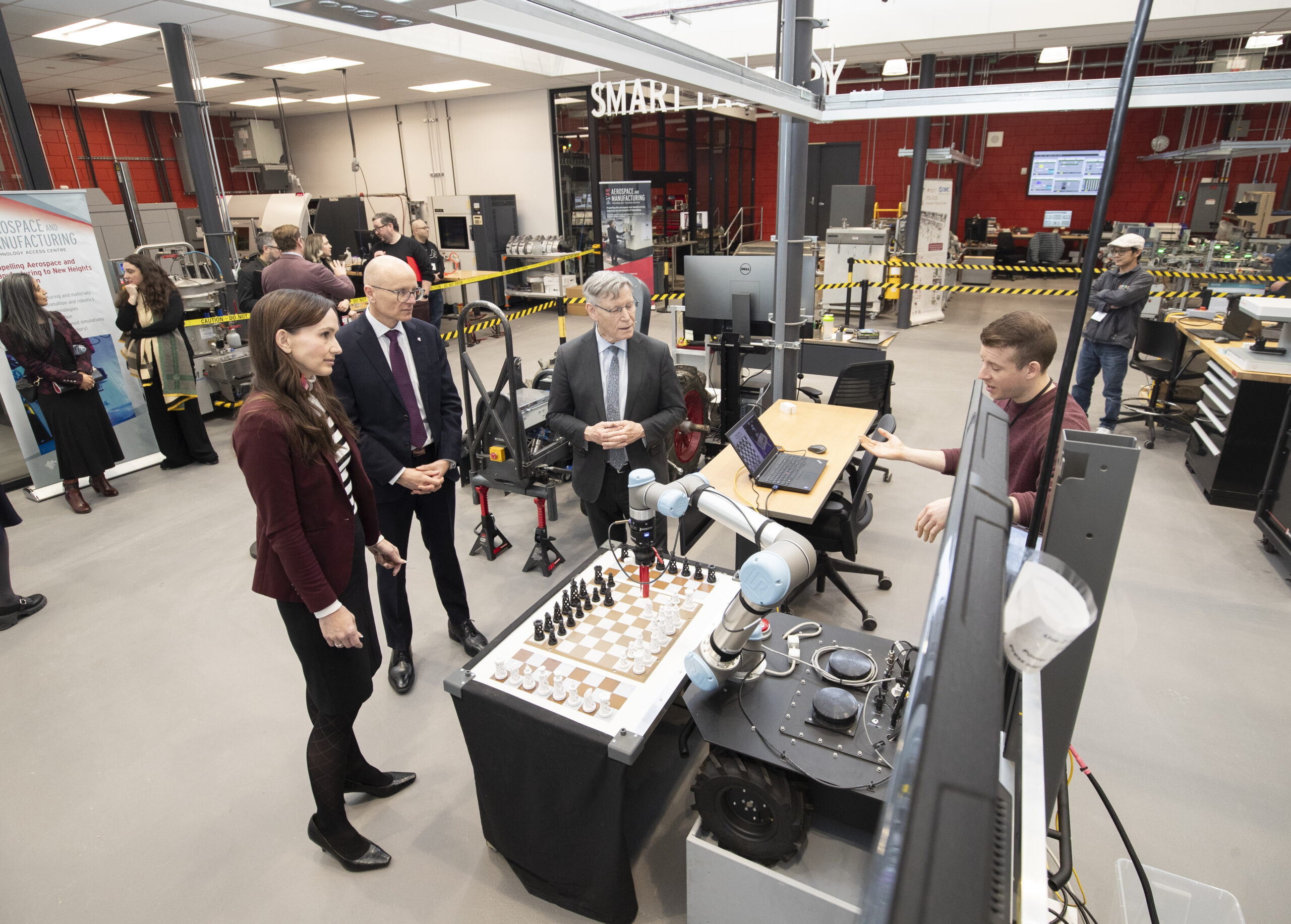 Another unique element is including both colleges and universities, as they traditionally take a different approach to research. The network is designed to maximize the strengths of all contributors.
“Canada is home to world-class researchers, who generate ground-breaking technologies and innovations, and they need support to successfully commercialize their work,” said the Hon. François-Philippe Champagne, Minister of Innovation, Science and Industry. “Through these networks, researchers will receive the support they need to bring their innovations to market, benefiting communities from coast to coast to coast.”
Canadian researchers continually make discoveries with extraordinary potential across all sectors of the economy and society, but additional guidance and support is required for their ideas to become the next great products and processes.
The infrastructure and expertise in industry-facing applied research found at Canada’s colleges and polytechnic institutions is critical for translating university-led academic research into innovation for the market and community users.
“This investment is a significant step in supporting Canadian researchers by giving them the tools, resources and support they need to turn their ideas into real-world solutions,” said the Hon. Terry Duguid, Minister of Sports and Minister responsible for Prairies Economic Development Canada, who was at RRC Polytech’s Notre Dame Campus to make the announcement.
“By connecting academic research with industry, we are helping to create new opportunities for innovation and economic growth across Canada.”
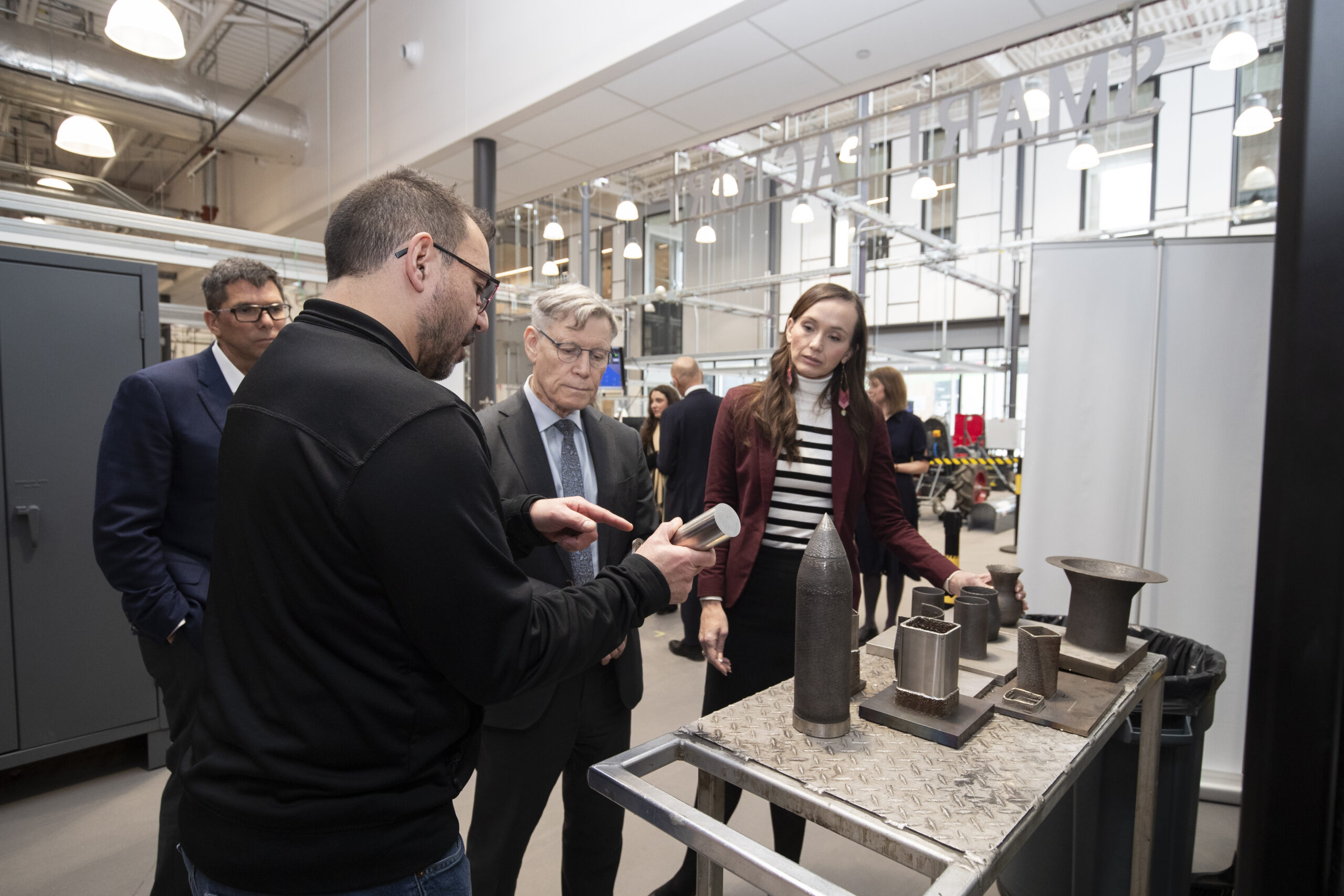 The new network will provide researchers with what they need to transfer scientific, social and service innovation to market or to community users. This support includes the sharing of best practices, digital resources to enhance awareness and knowledge of commercialization processes, mentorship and business coaching, financial assistance and access to an established Canada-wide network of Technology Access Centres.
RRC Polytech’s strong reputation for collaboration, central location and commitment to deepening partnerships and Truth and Reconciliation made it a natural fit to lead the network — another first, considering its size and scope.
“The college, university, community and industry partners in this initiative are the links in a chain of innovation and entrepreneurialism,” said Dr. Jolen Galaugher, RRC Polytech’s Executive Director, Research Partnerships and Innovation.
“By working together to ramp up productivity through the commercialization of Canadian research and IP, we’ll enhance our global competitiveness and positively affect all aspects of life for Canadians — economic, social or environmental.”
The Lab to Market initiative provides stable, long-term funding for all disciplines within the natural sciences, engineering, the social sciences, the humanities and health. RRC Polytech will immediately begin building capacity to lead its network of participants dedicated to fostering an entrepreneurial ecosystem that accelerates the economic and societal impact of Canadian research.
“Lab to Market grants bridge the gap between research ideas and their translation into economic and social innovation,” said NSERC President Alejandro Adem. “I can’t wait to see the results that will emerge from this new initiative.”
Co-applicant institutions:
British Columbia Institute of Technology, Cégep de Sherbrooke, Cégep de Thetford, College of the North Atlantic, Humber Polytechnic, Lethbridge College, Loyalist College of Applied Arts and Technology, MacEwan University, Mohawk College of Applied Arts and Technology, Mount Saint Vincent University, New Brunswick Community College, NorQuest College, Northern Alberta Institute of Technology, Northwestern Polytechnic, Nova Scotia Community College, Olds College, Red Deer Polytechnic, Saint Mary’s University, Saskatchewan Polytechnic, Selkirk College, Southern Alberta Institute of Technology, University College of the North, University of Alberta, University of Lethbridge, University of Manitoba, University of Regina, University of Saskatchewan, University of Waterloo, Western University, Yukon University
Collaborating partners:
MTA, NorthForge, Mitacs, Polytechnics Canada, Tech Access Canada, C2R2, Applied Pharmaceuticals Innovation, Edmonton Regional Innovation Network, CARIN, Calgary Innovation Coalition, Innovation Saskatchewan, Cultivate by Conexus, Synchronex, Axelys, Springboard Atlantic, Atlantic Colleges Atlantique
RRC Polytech welcomed Manitobans to the Notre Dame Campus today, as part of the 20th anniversary celebration of its Research Partnerships & Innovation (RPI) enterprise.
A gateway to applied research since its establishment in 2004, RPI connects industry and community partners with RRC Polytech’s comprehensive array of facilities, technology and expertise in collaborative projects that bring innovative ideas to life.
As part of the event, guests toured RRC Polytech’s research labs and areas, saw demonstrations of its leading-edge technology and engaged with faculty, professional research staff and students to learn how applied research projects connect all areas of the College and are driving our province into the future.
“As Manitoba’s polytechnic, RRC Polytech is committed to creating change through innovation and using the knowledge and tools that we offer to benefit our communities and the industries that our graduates will soon be leading,” says Fred Meier, RRC Polytech’s President and CEO.
“Applied research projects drive progress while providing students with invaluable experience through work-integrated learning. We’re eager to build on the incredible success stories we’ve shared with our partners over the last 20 years and to explore new opportunities to find solutions for real-world challenges.”
With 135 researchers and more than 600 students directly involved annually, along with applied research training enabled by research infrastructure in more than 60 courses, RRC Polytech is consistently named a top research college in Canada.
The College’s three NSERC-funded Technology Access Centres (TACs) and other various research facilities and resources are focal points for advancing knowledge, fostering collaboration and accelerating commercialization — with thousands of square feet of space to develop, test and create solutions to support small, medium and large enterprises and communities.
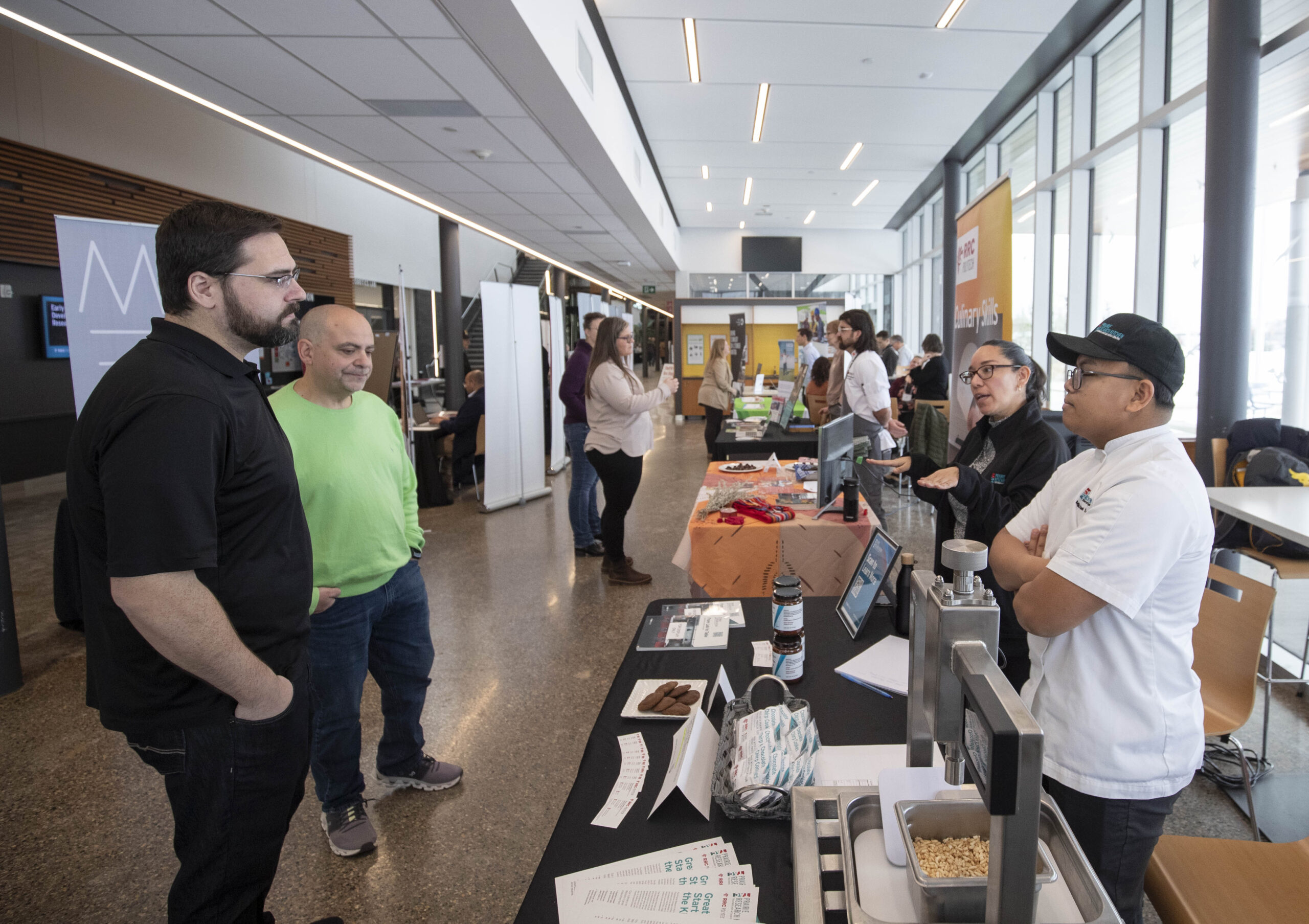 “We are proud to support RRC Polytech’s wide range of critical applied research projects because their creative collaborations with industry and community build on the strengths of the region and further diversify Manitoba’s economy to create opportunities for everyone,” says Dan Vandal, Minister of Northern Affairs and PrairiesCan.
“Polytechnics not only train the workforce of tomorrow but also support businesses with access to state-of-art facilities and by providing guidance on the research and development of new processes and products in various stages of technology readiness levels. Twenty years is a tremendous milestone, and we look forward to their future successes.”
Projects range from the development of the world’s first all-electric tundra buggies for Frontiers North Adventures in Churchill and the testing of cold spray technology to repair aircrafts with StandardAero to supporting CancerCare Manitoba during the COVID-19 Pandemic and studying the Abecedarian Approach in child care to partnering with Opaskwayak Cree Nation to develop food products for their community, just to name a few.
In its 20 years of existence, RPI has driven Manitoba forward economically, environmentally, socially and culturally – positioning the province for success in a globally competitive environment.
“RRC Polytech’s two decades of helping small- and medium-sized enterprises in Manitoba grow and evolve through applied research that spurs innovation is cause for celebration,” says Hon. Mike Moroz, Minister of Innovation and New Technology.
“As a former educator, I also commend how the College includes students in research activities — while they learn. Technology and innovation shape all facets of our society and economy; we need workforces and communities that are fluent and confident in this environment and that learning begins in the classroom.”
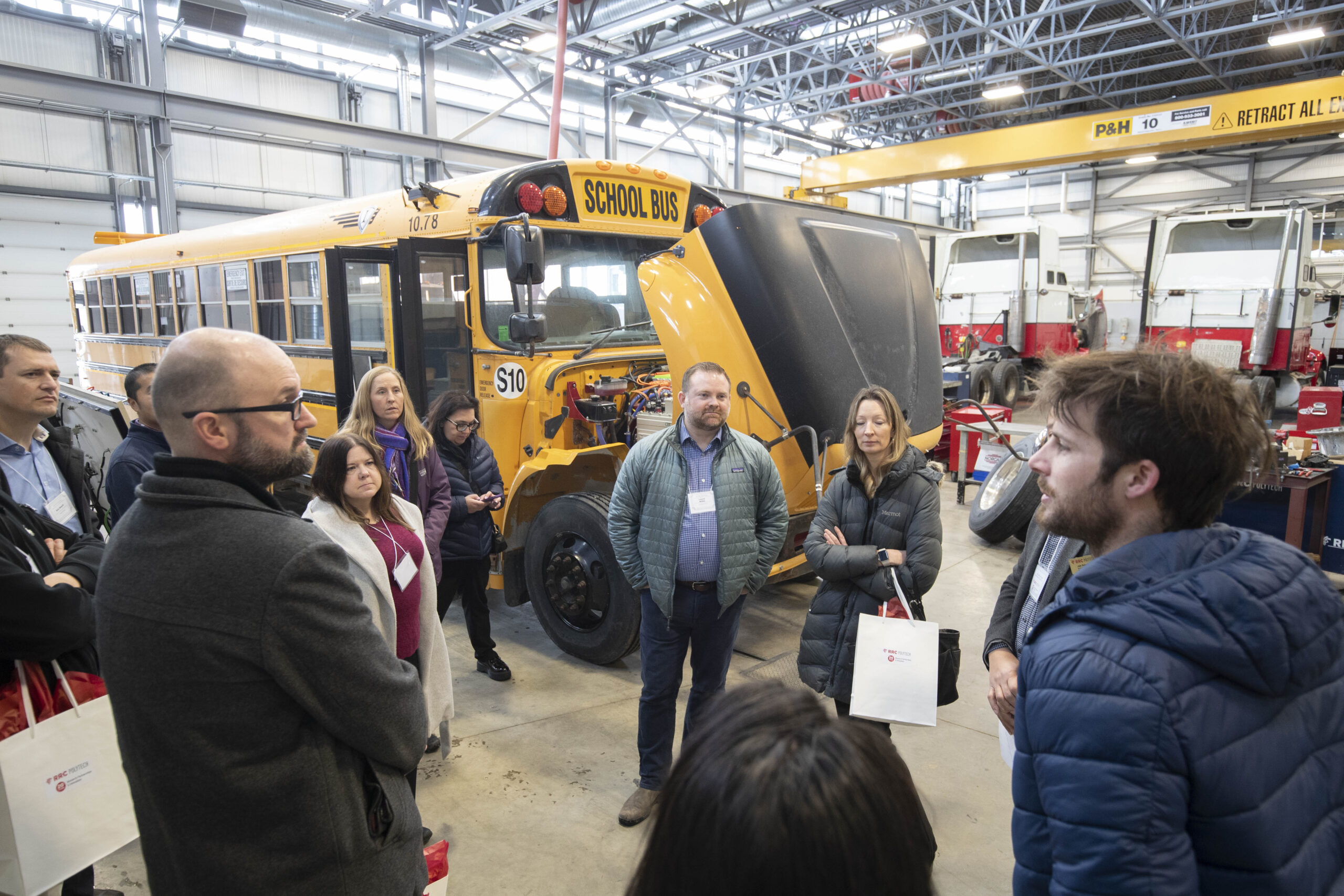 The applied research administered by RPI and conducted across all programs is foundational to RRC Polytech’s identity — a polytechnic is defined as an institution that fuels business innovation with applied research expertise. Applied research projects drive economic growth by helping to effectively and affordably solve problems for industry and communities, across all disciplines and sectors, as new products and processes are created.
To date, RPI has completed thousands of projects for clients and continues to expand its areas of specialization to:
• Advanced Manufacturing and Mechatronics
• Cleantech with focus on EV and building efficiency
• Health, nutrition and social sciences with focus on culinary research and food innovation
• Early childhood development research
• Enabling adoption of digital technologies including AI and automation
“The emerging technology we’re helping to develop amplifies the growing interconnectivity between all sectors, so the future of applied research is dependent on taking a multidisciplinary approach,” says Dr. Jolen Galaugher, Director, Research Partnerships & Innovation at RRC Polytech.
“RPI is uniquely positioned to take a leadership role in strengthening Manitoba’s research innovation ecosystem through its strategic partnerships and by cooperating with other post-secondaries, regional and national research labs, government departments, and industry associations.”
RRC Polytech is the only post-secondary in Canada to deliberately group Research with Indigenous Strategy and Business Development (ISRBD) into one portfolio.
This ensures that our commitment to embed Truth and Reconciliation is always a priority and establishes that all applied research respects the principles of OCAP® (Ownership, Control, Access and Possession) when working with and in First Nations, Inuit and Métis communities. It also creates natural overlaps that accelerate the ability to maximize Indigenous growth opportunities across the province.
“RRC Polytech has been demonstrating what is possible in Manitoba for 20 years. We want to thank our generous funders and supporters, and of course, all of our partners for trusting us to help achieve their goals by transforming their ideas into reality,” says Galaugher. “We look forward to building on those relationships as together, we’ll create a prosperous, sustainable and inclusive future for all.”
]]>